

Traditional loyalty programs focus only on purchases, not customer intent or behaviour, so they fail to build real long-term engagement. AI helps track browsing behaviour and user intent in real time instead of relying only on past purchases. An on-site intelligence layer like Rep AI reads these signals, and a reward execution layer like Smile uses them to deliver timely, personalized incentives that improve retention.
From Punch Cards to Predictive Intelligence
Customer loyalty in ecommerce is changing fast. Traditional programs focus on purchases, but they miss what customers are actually thinking and doing in the moment, making it harder to drive real retention and growth. Below, we’ll unpack why traditional loyalty programs are losing steam.
We’ll share what behavioral intent signals reveal that transaction data can’t, and how an agentic AI layer changes the equation. Then we’ll outline exactly how AI-powered customer loyalty strategies are driving growth for e-commerce stores. So, you can see what this looks like in a real store with a real shopper.
The Problem With Traditional Loyalty Programs
Here's the uncomfortable truth most ecommerce leaders won't say out loud: Enrollment is not loyalty. Points programs were built for a pre-AI retail world where the only signal a brand had about a shopper was the transaction itself. The whole model is straining under its own weight. Three structural cracks are showing.
First, traditional programs reward people who were going to buy anyway. Discounts are given to existing intent rather than generating new intent, which means the program is effectively subsidizing your best customers to do what they were already doing.
Second, members forget they're members. Most shoppers have no idea what their current points balance is. They never check and redeem, leaving real earned money dormant while the brand still carries the liability.
Third, and most damaging, are traditional programs blind to the 95%+ of traffic that doesn't convert on the first visit. They only “see” a customer after the money has already moved.
Meanwhile, CAC keeps rising, and organic reach keeps shrinking. Retention has to start before checkout, not after. A punch-card mindset can't survive that economy. Loyalty in 2026 isn't a discount mechanism anymore. It's a behavioural relationship, and only a real-time intelligence layer can actually run one of those.
Why Behavior and Intent Matter More Than Transaction History
Transaction history is a lagging indicator. Behavioural intent (what a shopper hovers on, asks about, abandons, and scrolls back up to) is the leading one. If you can read intent in real time, you can act on it in real time.
But if you can only read receipts, you're always responding to something that's already over. There are three real-time intent signals that predict repeat purchase behaviour far better than past orders:
- Hesitation signals (re-reading the return policy, long idle pauses, scroll-reversal on a product page) tell you a shopper is negotiating with themselves and hasn’t committed yet.
- Consideration signals (comparing two variants, asking about materials, sizing, or warranty) tell you a shopper is evaluating, not browsing.
- Expansion signals (asking about bundles, gifting, refill cadence, or subscriptions) tell you a shopper is ready to spend more than they came in to spend.
Most loyalty platforms are blind to every one of these. They live at the checkout, not in the conversation. By the time they “see” a customer, the hesitation moment is long gone. The opportunity is enormous.
Brands that read intent in real time can personalize the offer, the reward, and the moment, not just the receipt.
What AI Customer Loyalty Looks Like in Practice
Let's be precise about what AI actually adds to loyalty that a rules engine or a flow-builder simply cannot.
AI closes the gap between what a shopper feels in the moment and what a brand can respond to in the moment, at scale, with full context.
Three things AI brings to loyalty that traditional stacks can't match:
- Real-time personalization driven by live behaviour, not a segment exported from last quarter's CSV.
- Autonomous action like surfacing the right reward, reminder, or product at the exact right moment without a marketer hand-building a flow for every possible scenario.
- Unified intelligence, such as one view of sales, support, and shopper behavior, instead of four disconnected dashboards, none of which were built for loyalty in the first place.
But here’s the nuance most brands miss.
Not all “AI loyalty” is created equal. Most of what the market calls “AI customer loyalty” is really rules engines with an AI sticker on the box. Real AI customer loyalty is agentic. It makes decisions and takes actions inside the live session, within brand-safe guardrails, without a human scripting every branch in advance.
From Chatbots to Agentic AI-Powered Customer Loyalty
"Agentic," in plain English, means an AI that senses, decides, and acts autonomously inside guardrails the brand sets. It requires no flow-builders, trigger-based popups, or dev work.
An agentic AI-powered customer loyalty system has four jobs it has to do end-to-end. For instance, sense the intent the moment it forms, know the shopper's loyalty context without asking, decide the right move based on both, and act inside the conversation itself. Then, feed the outcome back into segmentation so the loyalty program keeps getting smarter.
"Agentic" doesn't mean unpredictable. An agentic AI-powered customer loyalty solution, such as Rep AI, operates on a multi-tiered control model with global instructions, channel-level instructions, and scenario-level skills. All are SOC 2 compliant and brand-safe by default. It's accountable autonomy, not the Wild West.
Where Rep AI Fits: The Onsite Intelligence Layer
Rep AI is the behavioral and conversational intelligence layer that sits on every page of your store and runs the loyalty relationship in real time. Here are four core feature pillars directly align with the crucial roles that agentic loyalty needs to perform:
Pillar 1: Sense Intent the Moment It Forms
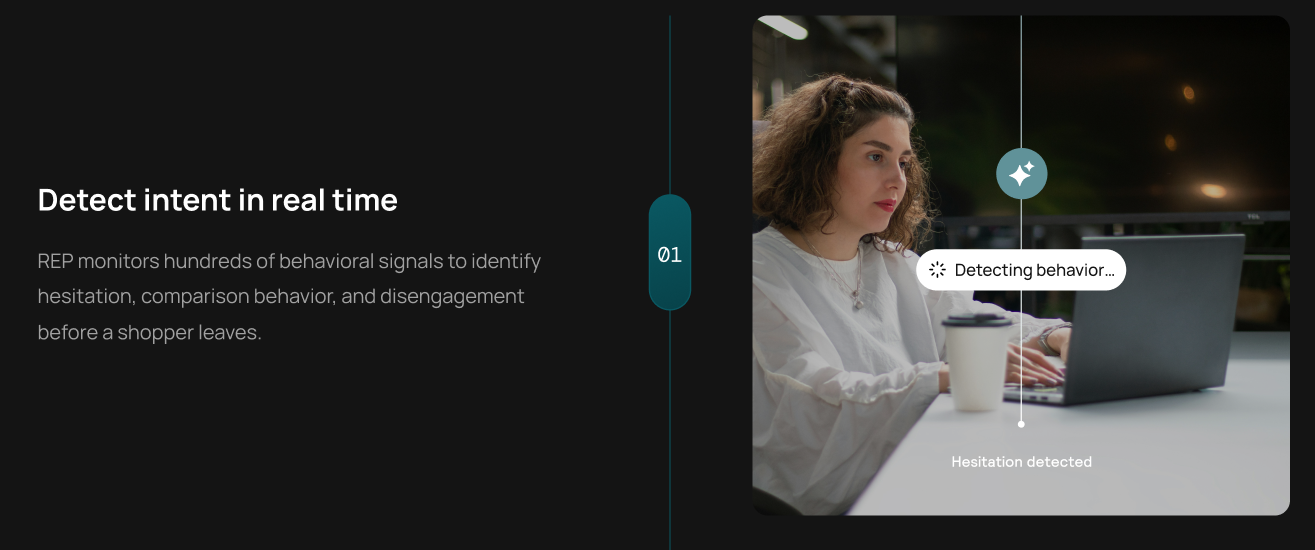
Rep AI’s behavioural engine reads abandonment signals (close-button hover, scroll reversal, long idle pauses) and consideration signals (back-and-forth between PDPs, sizing questions, policy re-reads) as they happen, mid-session.
This is the exact missing moment every traditional loyalty program loses, which is the instant a shopper is about to bounce. Rep AI doesn't wait for the exit survey. It acts before the exit.
Pillar 2: Know Every Shopper's Loyalty Context Instantly
The Smile integration pulls each logged-in shopper’s real-time points balance into Rep AI’s live context the moment they open the chat. Before the first message is even sent.
Point value is read from plain-language AI instructions the merchant writes once (“Each point is worth $0.10”), so there's no code, flow-builder, or developer in the loop.
Rep AI also already knows the shopper's location, cart contents, catalog context, and past conversations. Every data point the AI needs to behave like a brand's best returning-customer associate, at scale.
Pillar 3: Remember Every Shopper Like a Regular Would
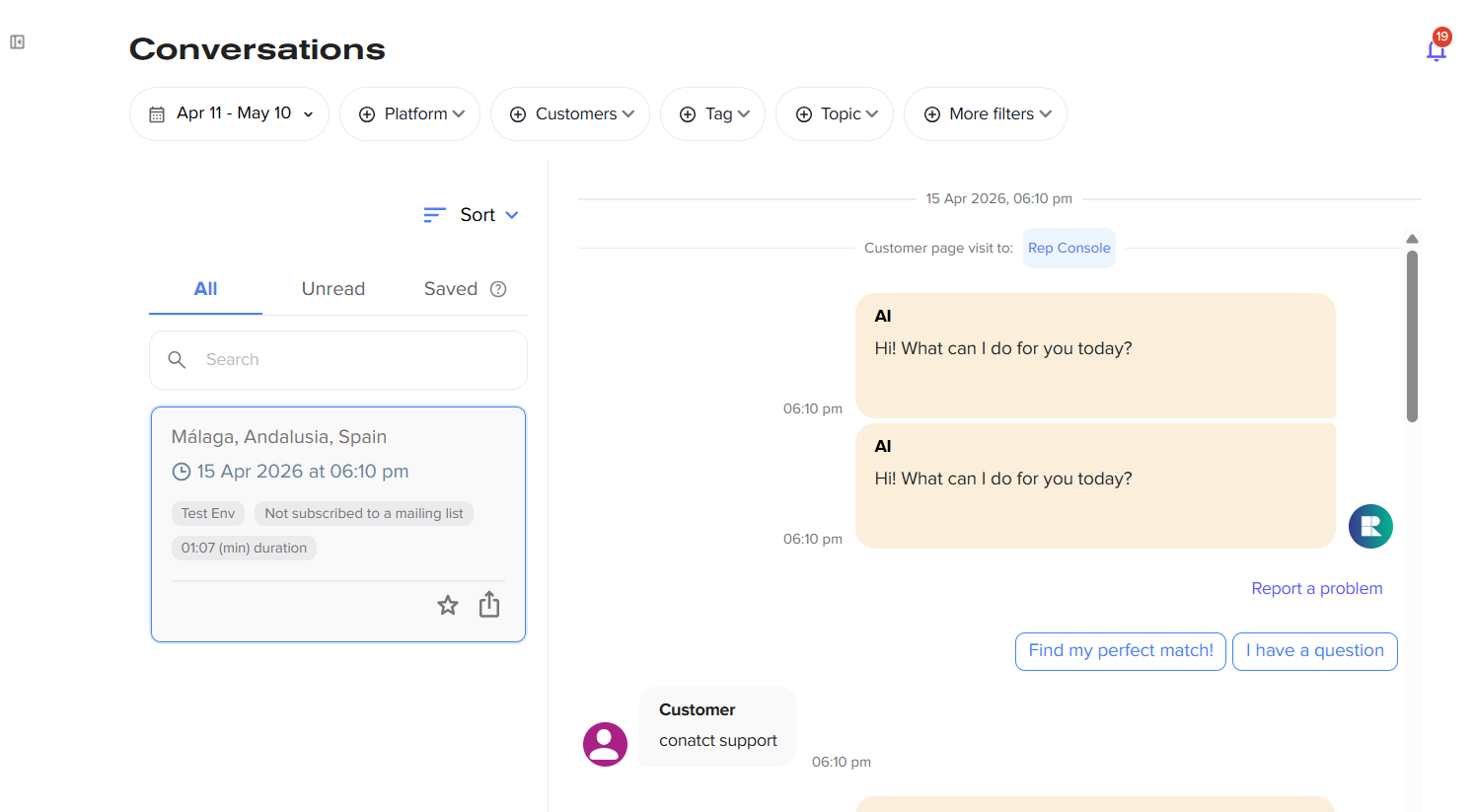
The single most underrated loyalty mechanic in retail is being remembered. Rep 2.0’s Recent Conversations feature shows returning shoppers a left-side panel with their chat history from the past 30 days (up to 50 conversations). With one click, they can reopen any conversation with the full AI context restored.
That means a shopper can pick up yesterday's product comparison, sizing thread, or order questions with zero repetition. It's the “you again, welcome back” moment that used to only exist in brick-and-mortar, now running natively inside your store, offering privacy-first, device-bound, and zero-merchant setup.
Pillar 4: Act Inside the Conversation, Not After It
This is where agentic commerce earns its name. Rep AI takes action inside the chat itself. Apply a Smile points redemption, and add to cart in one click. Then, offer a Subscribe-and-Get-Discount power-up that grows the Klaviyo list conversationally, trigger a Back-in-Stock notification, and surface Virtual Try-On on high-consideration items to protect LTV by reducing returns.
Every conversation, topic, and reward event then syncs back to Klaviyo in real time as enriched profile data. This feeds VIP-tier segmentation and post-purchase nurture without export scripts or brittle middleware.
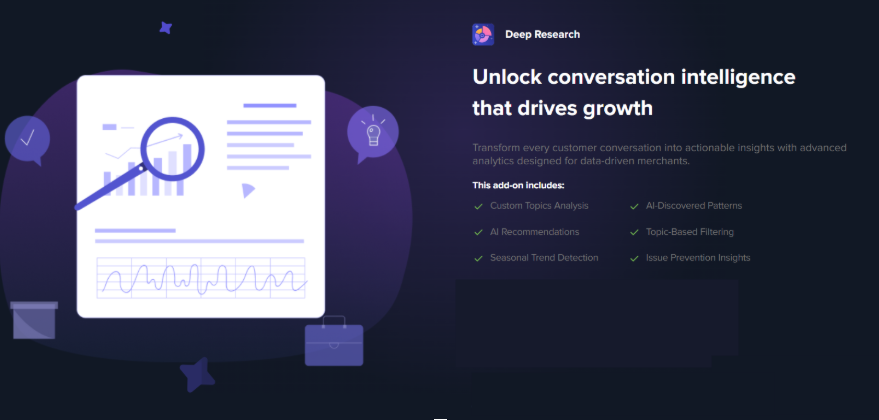
Deep Research closes the loop. It tells you what your loyalty members actually care about, so the rewards program itself can evolve around real signals instead of guesswork.
Across the 500+ Shopify and Shopify Plus brands, Rep AI already powers the platform. It delivers a 10 to 30% conversion lift, 50 to 70% ticket reduction, and 25% AOV uplift, with a 5X ROI guarantee in the first 30 days. Layering Smile's rewards engine on top of that is what takes the story from conversion to retained conversion.
Where Smile Fits: The Rewards Execution Layer
Smile is the rewards engine of record, featuring points, VIP tiers, referrals, redemption rules, program mechanics, and program economics. It owns the what and the how of loyalty at the ledger level, and is the category-defining loyalty platform for Shopify merchants.
The gap Smile alone can't close is a human one. Most customers forget they even have points. The reward exists, but the moment of recognition doesn't. That's the exact handoff point between the two layers. Smile governs the currency. Rep AI surfaces it at the precise second a shopper is about to bounce, or celebrate, or upgrade.
The integration itself is a 7-click setup inside Rep:
Console → Integrations → Loyalty → Smile → API key → Test connection → Save
Smart edge-case handling is baked in. Zero-balance shoppers never get awkward loyalty nudges, and almost-there shoppers get a reason to come back and earn more on their next order.
The Combined Workflow: Rep AI + Smile in Action
This is what happens when Rep AI and Smile work together in real time:
The Before Picture
Sarah, a returning skincare customer, lands on a product page on Tuesday evening. She has 300 Smile points (worth $30 off) and absolutely no idea. She drops a $45 moisturizer into her cart, hesitates, scrolls back up, and leaves.
Two weeks later, the brand sends a generic “we miss you” email. So, there’s no recovery. Three hundred points remain dormant and are a liability on the loyalty ledger. This is the traditional loyalty program's blind spot.
The After Picture With Rep AI + Smile
Sense. Rep AI's behavioral engine reads Sarah's hesitation pattern as an abandonment signal.
Know. The Smile integration has already pulled her 300-point balance into live context. Rep AI also knows she's a returning customer, what's in her cart, and, thanks to Recent Conversations, that she was comparing two moisturizers the night before.
Decide. Instead of a generic “Can I help you?”, Rep AI opens with, "Before you go, did you know you have 300 loyalty points available?”
Act. Sarah asks what that's worth. Rep AI reads the point-value instruction (“each point = $0.10”) and replies, "That's $30 off this order.” Sarah says yes. Rep AI applies the reward, completes the cart, and closes the loop, all inside the chat, with no tab redirects, or flow to maintain.
Learn. The conversation topic, reward redemption, and intent signal sync to Klaviyo as enriched profile data. While Deep Research picks up the behavior pattern. Marketing now has a high-intent VIP segment to nurture into a tier upgrade.
Sarah pays $15 instead of walking away. One conversation recovered a sale, redeemed a dormant reward, enriched a customer profile, and fed a loyalty upgrade path, with zero new automations built on the merchant side.
Why This Isn't Possible With Support-First Chat + Standalone Loyalty
Support-first solutions like Gorgias live in email, where conversion doesn't happen. Whereas standalone loyalty apps can only react after checkout, when the decisive moment has already passed. Only an agentic behavioral layer sitting on the store in real time can bridge the two, which is exactly the gap Rep AI + Smile closes.
Why Rep AI and Smile Are The Way Forward?
Modern loyalty isn't a punch card with better branding. It's an always-on, agentic intelligence layer that knows when to reward, who to reward, and why. Furthermore, it acts in the moment, inside the conversation, without asking marketing to build a flow for every possible scenario.
There are two quick ways to get started. If you’re already on Smile, install Rep AI in six clicks and turn on the Smile integration inside your Rep Console. In case you’re already on Rep AI, add Smile as your rewards execution layer and let the two layers work together.
Ready to Get Started?
The integration between Rep AI and Smile is live. For brands already running a loyalty program and using AI chat, this is one of the highest-leverage connections you can make. It takes two of your most valuable customer-facing tools and makes them aware of each other.
You can find everything you need to get connected below.
Book a 15-minute Rep AI demo →
This is a guest post written by Rep AI. Rep AI is an agentic commerce platform that helps ecommerce brands turn on-site conversations into revenue. It combines conversational AI, behavioral intelligence, and automated support to guide shoppers and reduce drop-off. Built for Shopify stores and beyond, Rep AI unifies sales and support in a single experience. Brands use Rep AI to increase conversion, grow AOV, and scale customer engagement


