

Customer acquisition keeps getting more expensive. Retention doesn't, and that's where the math actually works. Every retention team is chasing the same thing right now: know our customers better, and act on what we know faster.
The problem is that the data infrastructure most brands built between 2018 and 2022 was designed for a world that no longer exists. Third-party cookies are functionally gone. Apple's privacy changes have made attribution noisier. Inferred behavioral data still works, but it's a guess - and guesses don't scale into the kind of personalized experiences that mid-market and enterprise shoppers now expect. Meanwhile, the brands that have stopped guessing are quickly compounding ahead of everyone else.
This is where zero-party data has quietly become the most valuable asset in your stack. Not first-party data – zero-party. The information your customers explicitly volunteer about who they are, what they want, and why they're shopping with you. It's the only data type that gets more accurate over time, because customers update it themselves. And when you pair zero-party data collection with a loyalty program engineered to act on it, you stop guessing and start retaining.
Here's what that actually looks like, and why brands using Digioh and Smile together are seeing measurable lifts in repeat purchase rate, AOV, and customer LTV.
The Personalization Paradox
Shoppers now expect a brand to know them, and they can tell when one doesn't.
That gap is a data problem, not a creative one. Most brands have plenty of behavioural signals such as pages viewed, products clicked, carts abandoned, but those signals tell you what a customer did, not why. A shopper who clicked on three different sunscreens might be researching for themselves, gift-shopping for their mother, or comparison-shopping before buying somewhere else. Behavioral data can't tell you which.
Zero-party data can. And mid-market and enterprise brands are realizing that the competitors with mysteriously better email engagement, higher repeat rates, and more efficient paid spend ask better questions and reward customers for answering them.
What Zero-Party Data Actually Looks Like in DTC
Zero-party data is information a customer intentionally and proactively shares with a brand. Preferences. Purchase intent. Personal context. Motivations. The skincare brand that knows you're treating combination skin and post-partum hormonal changes. The pet brand that knows your dog is a senior labrador with a chicken allergy. The apparel brand that knows you're shopping for a wedding in October.
It's information the customer chose to give you. Not data you bought from a broker, not signals you inferred from clicks - info given to you because they wanted a better experience in return.
The collection mechanisms most often look like:
- Pre-purchase quizzes that recommend products based on declared preferences
- Welcome flow surveys that segment new subscribers from the first touch
- Post-purchase profile builders that enrich customer records over time
- Preference centers customers manage themselves
- Progressive forms embedded in landing pages and account areas
The mistake most brands make is collecting this data and then doing nothing meaningful with it. The data sits in a customer data platform, a few merge tags get added to email flows, and nothing changes for the customer. Now, the next time you ask them a question, they don't bother answering, because they've already learned that telling you things doesn't get them anything.
How leading DTC brands actually collect zero-party data at scale (without killing conversion)
The brands winning right now share one thing: they know who's shopping. Not inferred - declared. Digioh is the identity-driven personalization platform that makes that possible. They help DTC brands identify who's on their site, capture what those shoppers explicitly share about themselves, and activate that data across the entire stack - so every downstream experience gets smarter, not just the first one.
The key strategy is guided selling. A “quiz” isn't simply a lead capture or product recommendation tool - it's a core moment in a customer journey. Obvi switched their quiz journey to Digioh and saw completion rates jump from 45% to 80% - because when a quiz is properly built to help the shopper find the right product in context, they complete it. IGK Hair used that same approach to grow color sales 30% and lift AOV 19%. Criquet Shirts used Digioh Passport to recognize visitors even after cookies cleared, leading to $271K in revenue in 30 days, doubled conversion rates, and 97x ROI.
Across the board: brands adding a product quiz average 3x more conversions than standard site navigation.
What separates this from the "data sitting in a CDP" problem is identity. Every quiz answer, every declared preference, every on-site signal feeds into a persistent shopper profile that travels across sessions and devices. All that wonderful customer context syncs to Klaviyo as real customer attributes - not merge tags, but actual segmentation inputs that trigger flows reflecting what someone told you about themselves and where they are in their customer journey.
With Smile loyalty data living right there in Klaviyo as well, your points logic, VIP triggers, and retention flows are all working from the same picture of who the shopper actually is. Every time a customer comes back, Digioh helps the brands pick up the conversation right where they left off.
Zero-party data only compounds if the system acts on it. That's the part most brands are still missing.
Activating Zero-Party Data Through a Loyalty Program
Most loyalty programs are still being run as a retention tactic. However, they can actually be the most powerful activation layer you have for the zero-party data you’ve already collected and that’s where the math changes.
When a customer tells your quiz that they have sensitive skin, that data point can do a lot of work, but only if something is built to use it. A well-designed loyalty program is that something. It can:
- Reward customers for filling out a profile with bonus points, turning data collection from a one-way ask into a two-way value exchange
- Promote rewards by declared preferences, so the sensitive-skin customer can redeem rewards for sensitive-skin products specifically - not a generic catalog
- Trigger personalized point bonuses around the moments customers told you mattered (birthdays, anniversaries, gifting occasions)
- Segment VIP experiences by interests, so your top-tier customers get the experiences they actually want, not the ones you guessed they'd want
- Re-engage lapsed customers with offers built from what they told you, not what you assume
The compounding effect is real. When customers see that telling you about themselves results in better rewards, more relevant emails, and a smoother shopping experience, they become more loyal and they tell you more. Profile completion rates go up, re-engagement rates go up, and the data you have on file gets richer over time.
This is what we mean when we talk about loyalty as the activation layer. Relevance is the product. Points, perks, and VIP tiers and exclusive brand experiences are how you deliver it.
The Flywheel: Capture → Activate → Re-capture
The brands getting the most out of this approach are running it as a flywheel where every quiz answer compounds into a more intelligent next interaction.
Capture happens at every customer touchpoint where it makes sense to ask a question. This could be a pre-purchase quiz on the homepage, a post-purchase survey in the order confirmation, a profile expansion prompt in the account area. Digioh handles the surfaces and elegantly collects this customer feedback.
Activate happens the moment that data flows into the customer record and the loyalty program. The customer’s declared preferences can be used to personalize rewards, exclusive experiences and VIP communications. The customer experiences the brand differently because the brand actually knows them.
Re-capture is the underrated third step. Once customers see the value, you ask them more and reward them for answering (e.g. A "complete your profile" prompt,, a seasonal preference refresh, or a "tell us about your goals for the year" prompt in January all of which can earn the customer points). The profile gets deeper. The personalization gets sharper. The LTV curve bends. And the customer feels understood and rewarded.
Getting Started: A 90-Day Playbook
You don't need to rebuild your stack to start running this play. Most enterprise brands can stand it up in a quarter.
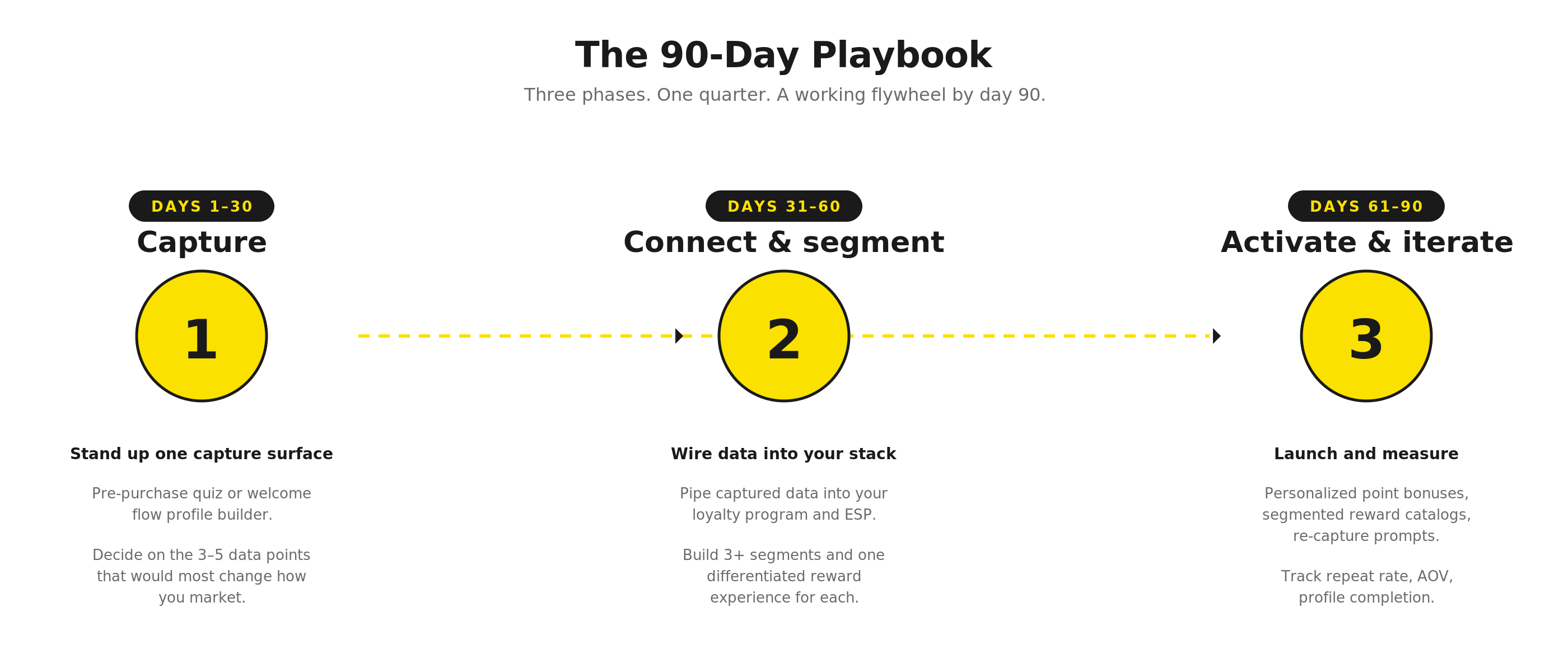
Days 1-30: Capture. Stand up one zero-party data collection surface that earns its keep - typically a pre-purchase quiz tied to product recommendations, or a welcome flow profile builder. Decide on the 3-5 data points that would most change how you market to a customer if you knew them.
Days 31-60: Connect and segment. Pipe the captured data into your Smile loyalty program and your ESP (like Klaviyo). Build at least three customer segments based on declared attributes, and design at least one differentiated reward experience for each.
Days 61-90: Activate and iterate. Launch personalized point bonuses, segmented reward catalogs, and re-capture prompts. Measure the lift in repeat purchase rate, AOV among loyalty members, and profile completion rate. Use the data to design the next round of questions.
The goal in the first quarter is to build the loop. Refinement comes after. The more zero-party data you collect the smarter your systems and campaigns will be, and iteration on the program will keep your flywheel spinning.
The Bottom Line
The brands winning the next phase of DTC are turning every customer interaction into an exchange that makes the next interaction better. Paid budget isn't the deciding factor anymore. Zero-party data is the input. Loyalty is the activation. That flywheel is the moat.
If you're a mid-market or enterprise brand thinking about how to build this stack, we put together a more detailed playbook with benchmarks, sample quiz flows, and reward program templates.
Ready to get Started? See how Smile and Digioh work together
Already on both platforms?


