
Every Shopify brand running a loyalty program can tell you who joins it. The shoppers that make a purchase are enrolled in your loyalty program, become email subscribers and turn into repeat purchasers. They are brought into the brand's ecosystem and are recognized for it. The people who never make it that far, the ones who build a cart, reach checkout, and leave, may never hear from the loyalty program at all.
That's a large pool to leave untouched. A checkout abandoner already did the hard part: found a product, added it, started to pay. Some of that group opted into email or SMS along the way and some didn't, and the ones who didn't sit outside every automated flow a brand runs, no matter how well built. No consent, no message, no chance to come back.
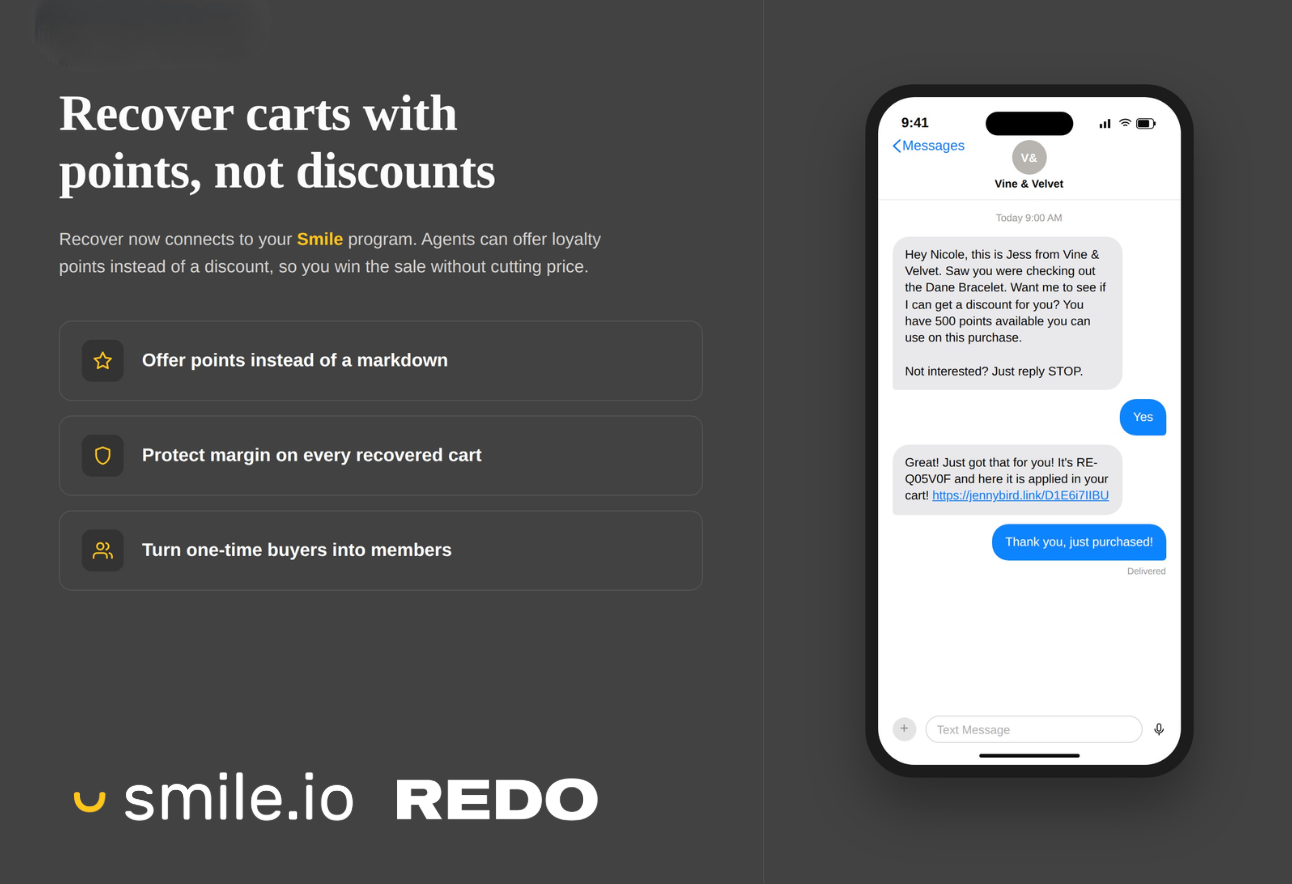
Smile now integrates with Redo Recover, the Shopify app that works that exact segment through live, one-to-one text conversations instead of automated sequences. With the integration live, Smile's points balance and the points they'd earn by finishing the order now show up right inside those recovery messages.
What is cart abandonment recovery, and why do most flows stop short?
Standard cart abandonment recovery runs on consent. Klaviyo, Attentive, Postscript, and similar tools trigger a sequence the moment a shopper who's already opted in leaves checkout. It's a real channel, and brands should keep running it.
The limitation isn't the technology. It's the list. A flow can only message someone who agreed to be messaged. Shoppers who abandon checkout without ever subscribing sit outside every automated sequence a brand runs, no matter how well built. They show up in analytics as a bounce and nothing else.
Redo Recover was built for that specific group. Trained agents send personalized, one-to-one messages under peer-to-peer messaging rules, which allow compliant outreach without a prior opt-in the way bulk marketing requires. Because it's a live conversation, an agent can respond to whatever's actually holding a shopper back, a shipping cost, a sizing question, a payment issue, instead of guessing at it with a generic discount.
For teams weighing the compliance question before they weigh the revenue one: agents honor opt-out requests immediately and work within quiet-hours rules built into P2P messaging, so this runs as a separate, auditable channel rather than a workaround for consent requirements elsewhere in the stack.
How Smile shows up in the conversation
Before this integration, the main lever in a recovery conversation was a discount code. Effective, but also the most expensive tool available: every dollar of it comes straight off margin, on an order that hasn't happened yet.
With Smile connected, agents have a second lever that costs nothing until the order does. The recovery message itself can now show a shopper their Smile points balance and what they'd earn by finishing the order, right alongside the conversation about why they left. That reframes the purchase around value already earned instead of a price cut.
There’s a second-order effect worth naming, too. A shopper recovered through Redo checks out the same way any shopper does, which means they’re enrolled in the store’s Smile program under whatever rules the brand already has set up. A brand isn’t just recovering one order. It’s converting a shopper who was invisible to every other retention channel into someone with a points balance and a reason to come back.
Why points hold up better than a discount in this exact moment
A discount code is a permanent cost against a single order, applied the moment it's used. Points are a deferred cost that only lands if the shopper redeems them, and if they come back to redeem them, the brand has already won the harder part: a second purchase it didn't have to pay to acquire through ads.
There's a behavioral cost to discounting, too. Smile has written before about how a shopper introduced to a brand at a discount gets conditioned to expect one on every order after that, and how heavy discounting can read to shoppers as a signal a product is overstocked or a business is struggling. Leading with points instead of a percentage off protects margin now and pricing perception later.
Redo’s agents aren’t limited to points. They can still lean on a discount, free shipping, or a gift when a shopper needs one. What this integration changes is the order of operations: points can lead, and discounting becomes the fallback instead of the default.
The points already in your program are a recovery asset
There’s a second reason this matters, and it has nothing to do with the specific order in front of an agent. Every Smile program is carrying a balance of points members earned on past orders and haven’t spent yet: real value that just sits there until something puts it back in front of them.
A recovery conversation is one of the few moments that can. Putting the balance directly into that conversation turns a number a shopper might never think to check into a reason to finish the order they were about to walk away from. (Our guide to loyalty program analytics walks through how to see that balance across your own program.)
One conversation, two outcomes worth tracking
The revenue outcome is the one Recover is built to prove out on its own: it works the segment your subscribed-audience flows can’t reach, and those flows keep running exactly as they are alongside it.
The harder outcome to put a number on is what it does to how that customer experiences the brand going forward. A shopper who gets a real answer to a real question, then gets rewarded for finishing an order instead of just discounted into it, starts the relationship differently than someone who bounced and got a generic 10%-off email three days later. Every downstream metric, purchase frequency, lifetime value, program engagement, is ultimately a proxy for one question: did that first moment make the customer feel recognized, not just processed.
Getting started
Setup is quick. Install Redo Recover from the Shopify App Store, then connect Smile, either from inside Redo or directly from Smile Admin, to turn the integration on.
Redo's pricing is performance-based. There's no cost until Recover drives revenue, backed by a guaranteed 10x return.
Talk to our team
If you're leading loyalty, retention, or CRM at a consumer brand and want to see this against your own checkout data, talk to our team at Smile. We'll walk through the setup, what it looks like for your customers, and what it means for retention and lifetime value in your category.
