

Guest Post by Simple Bundles
Getting a customer to add one more product to their first order is valuable.
Getting them to discover three products they love, and giving them a reason to come back for all three, is even better.
That's part of what makes product bundling such an interesting strategy for Shopify brands. Bundles can increase average order value in the moment, but they can also introduce customers to more of your catalog, make replenishment easier, turn frequently purchased products into routines, and create better offers for your most loyal shoppers.
The difficult part is finding the right bundle app.
So rather than looking for one universal winner, here are seven Shopify bundle apps to consider in 2027 based on what each one does particularly well.
| App | Best for | Starting price | Rating |
|---|---|---|---|
| Simple Bundles & Kits | Customizable bundles | Free / $14/mo | 4.9/5 |
| Easy Bundles | Build-your-own boxes | Free / $29/mo | 4.9/5 |
| Fast Bundle | Bundle merchandising | $19/mo | 5.0/5 |
| Rebolt Upsell & Bundles | Promotions and cross-sells | Free and paid plans | 4.8/5 |
| Kaching Bundles | Quantity breaks | $14.99/mo | 5.0/5 |
| Shopify Bundles | Simple fixed bundles | Free | 2.8/5 |
| Bundles.app | Inventory synchronization | $19/mo | 4.9/5 |
1. Simple Bundles & Kits: Best for customizable bundles that grow with your store
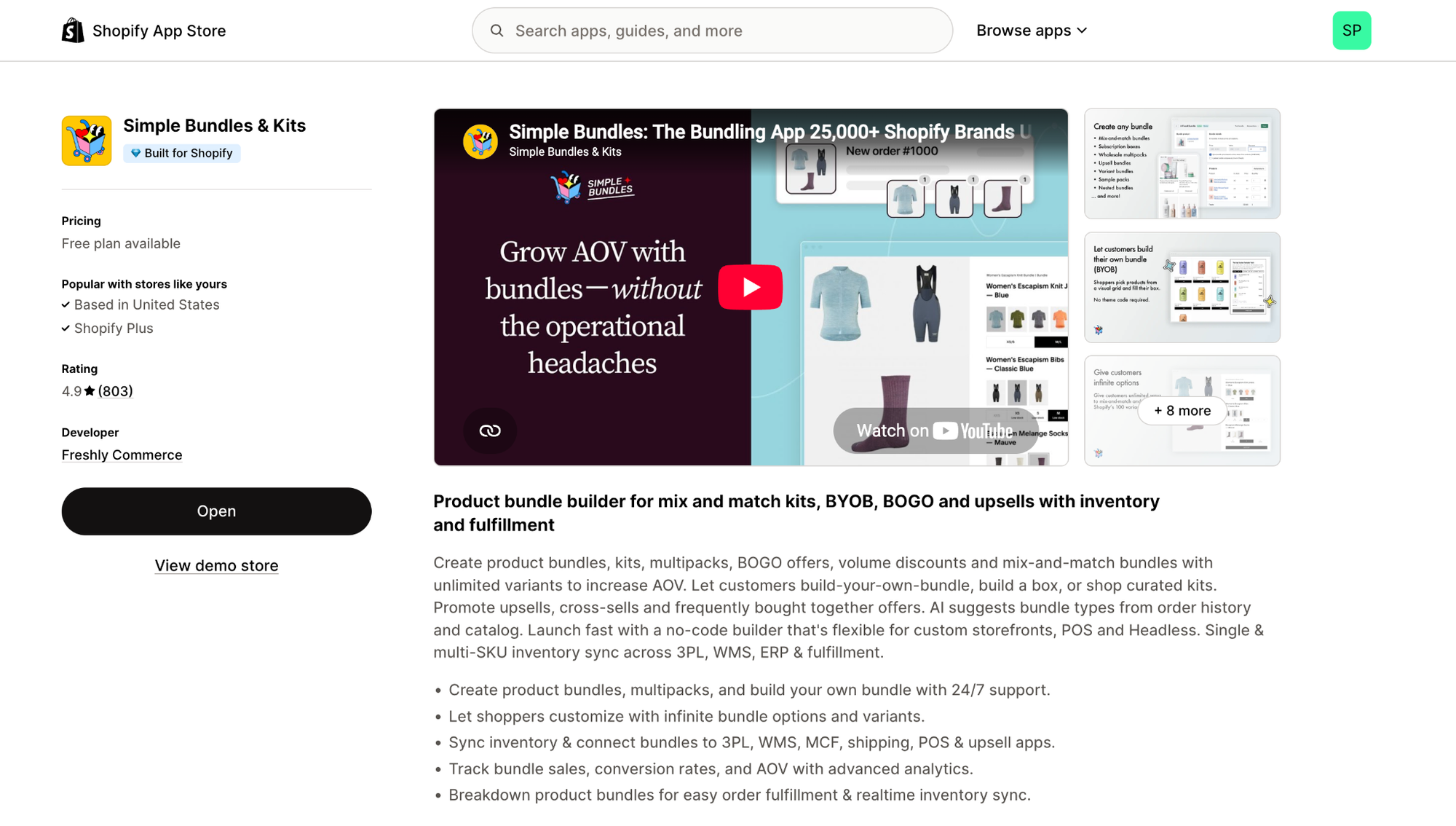
Simple Bundles is built for brands that don't want to choose between a good-looking bundle on the storefront and a bundle that behaves properly behind the scenes.
Merchants can create fixed bundles, multipacks, mix-and-match bundles, build-your-own bundles, build-a-box experiences, BOGO offers, volume discounts, product add-ons, cross-sells, upsells, and frequently bought together recommendations.
And those experiences aren't restricted to one standard bundle widget.
Brands can customize how their bundles are presented to shoppers with elements such as product and color swatches, variant selectors, quantity pickers, dynamic pricing, product imagery, and different bundle layouts. That customization extends across the different bundle types Simple Bundles supports, so the experience can feel like part of the brand rather than an app layered awkwardly onto the storefront.
Brands that don't need a highly custom experience can also launch without code, while more advanced merchants can extend the setup further, including Shopify POS and headless storefronts.
Where Simple Bundles becomes especially useful
Once a customer checks out, Simple Bundles can connect the customer-facing bundle to the individual component SKUs underneath it.
That means the polished “Build Your Routine” experience a shopper sees can still become a clear list of cleanser, moisturizer, serum, and SPF for the fulfillment team.
Inventory can remain connected to those real products too.
That's increasingly important if a store has:
For brands using bundles to encourage product discovery and repeat purchasing, that flexibility also gives you room to evolve the offer.
You might begin with a fixed starter kit, introduce a build-your-own version for returning customers, offer larger multipacks to frequent buyers, and merchandise complementary products as upsells. All without needing a completely different bundle architecture each time.
You want the freedom to customize how different types of bundles look and work for customers while keeping the individual products, inventory, and fulfillment workflows connected underneath.
It's particularly strong for brands that expect bundling to become a bigger part of both acquisition and retention over time.
2. Easy Bundles: Best for build-your-own boxes and curated experiences
There is a big experiential difference between clicking “add bundle to cart” and actually building one.
Easy Bundles specializes in the latter.
Merchants can create step-by-step build-your-own experiences where shoppers choose products from different groups or stages until their box is complete.
That makes it especially interesting for categories like:
- Snacks
- Coffee and tea
- Beauty
- Gifts
- Subscription boxes
- Wellness products
- Corporate gifting
Take a six-item snack box.
Instead of scrolling through one enormous collection, they might choose two sweet products, two salty products, and two drinks in separate steps.
Breaking it into steps makes a larger purchase feel easier..
Easy Bundles also supports other configurations such as fixed bundles, mix-and-match offers, quantity breaks, free gifts, subscriptions, and product add-ons.
Why that can matter for retention
Build-your-own experiences can work particularly well once customers already know your catalog.
A first-time shopper may appreciate a curated starter kit.
A returning customer may prefer the freedom to create a box containing only their favorites.
Giving those customers more control can turn a generic replenishment purchase into a more personalized experience.
A guided, interactive box-building experience is the heart of your bundle strategy.
3. Fast Bundle: Best for merchandising bundles throughout the store
Sometimes the challenge isn't creating the bundle.
It's getting customers to discover it.
Fast Bundle supports a broad set of promotional and merchandising formats, including fixed bundles, mix-and-match bundles, build-your-own experiences, BOGO offers, Buy X Get Y promotions, quantity breaks, volume discounts, free gifts, product add-ons, frequently bought together recommendations, and product-page upsells.
That gives merchants several opportunities to introduce a larger purchase.
Someone viewing a single moisturizer might see the complete skincare routine.
A shopper buying coffee could see a discounted three-bag option.
Another customer might qualify for a free product after reaching a certain purchase threshold.
Fast Bundle also supports bundle offers through Shopify POS.
You want to experiment with lots of bundle, discount, upsell, and cross-sell formats across the shopping experience.
4. Rebolt Upsell & Bundles: Best for promotional bundles and cross-sells
Rebolt approaches bundling largely as a merchandising and AOV strategy.
Its bundle tools include options such as mix-and-match bundles, combo offers, quantity and tiered discounts, and cross-sells. Merchants can also place bundle offers on product pages or create dedicated bundle experiences.
That gives stores flexibility in how aggressively they want to push the offer.
A merchant might have a permanent product bundle that groups complementary items together while using a quantity discount elsewhere to encourage customers to stock up.
This can be particularly useful for products customers already understand and don't need much education around.
For instance, someone who regularly buys dog treats probably doesn't need to be convinced that they'll eventually use three bags. The offer simply needs to give them a compelling reason to purchase those three bags today.
You want flexible promotional bundles and cross-sells without making bundling the operational center of your Shopify setup.
5. Kaching Bundles: Best for quantity breaks and stock-up offers
Some of the most effective bundles are barely bundles at all.
They're simply:
Buy 1 for $25, Buy 2 for $45, Buy 3 for $60
Kaching Bundles focuses heavily on this type of offer.
It supports quantity breaks, volume discounts, bundle deals, frequently bought together offers, and customizable storefront widgets.
Built-in A/B testing lets you compare offers instead of guessing which incentive converts best.
And quantity breaks can have benefits beyond first-order AOV.
For replenishable products, getting a customer to purchase three units at once can make their next purchase more convenient while increasing the amount of product they've incorporated into their routine.
That can work particularly well for:
- Supplements
- Pet products
- Food and beverages
- Skincare
- Personal care
- Household products
Your bundling strategy is primarily about stock-up offers, quantity breaks, and optimizing promotional widgets for conversion.
6. Shopify Bundles: Best for simple fixed bundles
Shopify offers its own free Bundles app for relatively straightforward use cases.
Merchants can create fixed bundles and multipacks directly through Shopify, with inventory connected to the products contained inside the bundle.
Customers can also select relevant product variants such as size or color.
For example, you could sell:
- A shampoo and conditioner duo
- A three-pack of T-shirts
- A basic skincare routine
- A coffee and mug gift set
- A starter kit for a new customer
That may be everything your store needs.
Where Shopify Bundles become more limiting is when the bundle itself needs to become a richer merchandising experience, such as a build-your-own box, a broader upsell strategy, or more complex promotions.
You need simple fixed bundles or multipacks and want to start with a free native Shopify option.
7. Bundles.app: Best for stores prioritizing inventory synchronization
Consider a candle gift box containing three individual scents.
Every candle is also sold separately.
If one scent runs out, you can no longer make the complete gift box, even if the “gift box” product itself technically has inventory remaining.
That relationship is where inventory-focused bundle apps become useful.
Bundles.app places a strong emphasis on synchronizing inventory between bundles and their component products and supports configurations including fixed bundles, multipacks, curated sets, tiered pricing, and mix-and-match options.
This can be especially useful when the customer-facing experience is relatively simple but the underlying inventory relationships aren't.
Component-level inventory is the biggest reason you need a dedicated Shopify bundle app.
Which Shopify bundle app is right for your store?
If bundles are becoming a major part of your merchandising strategy, you'll need to think about storefront flexibility and backend operations together.
A good bundle strategy goes past a larger first order. It helps customers find more products they enjoy.
